Suikoden (1995) is my comfort game
I don't exactly remember how I got my original Sony PlayStation, but it was either my 9th or 10th birthday. It was after I had moved from my childhood home outside Bryan, Texas into the city proper but before I lost contact with the neighborhood crew. The PlayStation was near the end of its run, and fairly affordable. I didn't specify any games to my parents so they took a gamble and one of those was on a niche game called Suikoden.
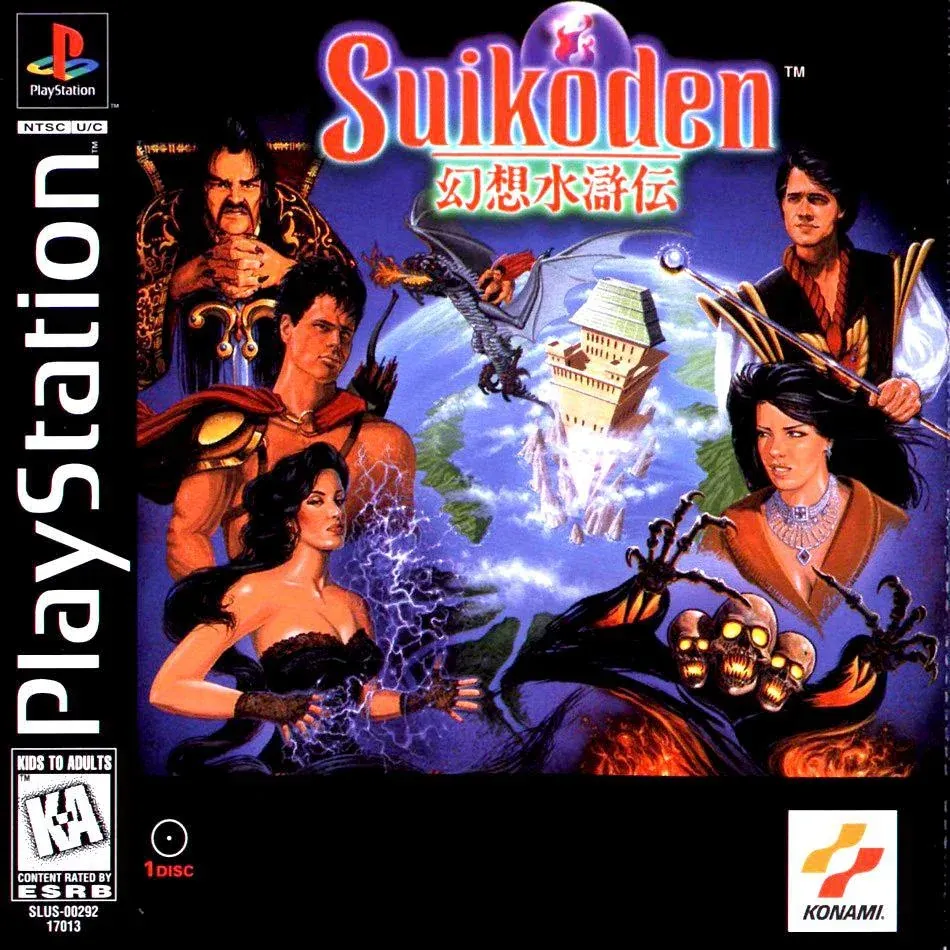
I'll be honest, the cover art does not inspire much confidence. There is another cover that looks much less weird, but this was the one my parents brought home. You have your castle from the game, but also a weird man in his 20s or 30s holding a wand (who I think is supposed to be the protagonist) a witchy woman who isn't in the game, and a random monster - it is a bizarre mess that looks at home in a movie bargain bin. But I decided to pop it into my new PlayStation and give it a try. My parents said the clerk helped them pick out an fantasy game for me, and they knew my tastes better than I did.
I let the opening movie play.
The audio quality was better than any other game I had played. This was a movie soundtrack. The clouds, the sweeping camera, the deep colors, it all drew me right in and simply hasn't let go. It was one of the games that made me love video games as a medium for storytelling.
Suikoden was the first video game I fully beat. I beat it again when I found GameFAQs a few years later and finally recruited all 108 stars. I've beaten it several times, and the sequel only a few times short of that. Why am I still so enamored with this series?
The Scale
The scale was novel to me. There isn't an existential threat in the bones of the story. The scope is national, focusing deeply on mortal politics and questions of sovereignty and power. The story is set in one region of a much greater world. There are high stakes, personal drama, and peril.
I think this is why the older Fire Emblem games resonated so much with me. I like fantastical settings that feel familiar, and focus on war as geopolitical change (as much as I am a dove in real life).
Suikoden 1 takes place completely within The Scarlet Moon Empire. It’s heavily inspired by Water Margin, a foundational text in Chinese literature. Much like the inspiration, 108 heroes join together for justice against government corruption.
In addition, while there is magic, it is interwoven into the world. Yet, there’s still a sense of mystery and wonder around the 27 True Runes. Different regions have distinct cultural identities, with music fitting the locations.
The Systems
There’s a variety of battle modes. Most of the gameplay follows fairly standard JRPG style. Travel an overworld to a town or dungeon, fighting random encounters with your individual squad until you get to the boss. The small party was larger than other JRPGs I had seen - six party members. All the better to play with the massive army you could recruit. Your protagonist Tir could recruit 107 other ‘Stars of Destiny’, most of whom could be part of your combat squads. They each had their own weapon, armor types they could wear, stat spreads, spell growth, and identities.
The magic system was unique - rather than pre-sets spells, characters gained spell slots per level at differing rates. Some people had a fixed rune, but most did not, adding another layer of customization. Some characters were better for a rune that cast spells such as the Cyclone Rune (my personal favorite), or were hopeless at magic and would be better with the powerful Double Beat rune.
Rather than switching out weapons, character’s weapons are upgraded at a blacksmith, by sharpening them or by embedding rune fragments in them. The rune system and sharpening system were massively deepened in the sequel where certain characters got more rune slots, allowing for deeper customization.
Outside of standard battles, Tir would also occasionally have to engage in dramatic duels or lead the army in full scale battles. These were rock-paper-scissors games, but your investment kitting out Tir or recruiting optional Stars made you more effective in them. They were another form of story telling all together.
Finally, much of the gameplay takes place at your castle. Not all of the Stars are fighters - there’s innkeepers, mini-games, shops, and collectibles. Collecting and unlocking these encourages exploration and pads out the game’s run time.
The Gameplay Loop
There are clear arcs in the story and the game encourages you to breathe between those arcs. If I only have a half hour to an hour to play, I can spend that time finding lost collectibles, farming for drops or levels to upgrade my fighters, or play the absolutely unbalanced gambling dice mini-game and never worry about money. And, most importantly, every arc opens up a new batch of Stars of Destiny to meet and recruit. Some of them have a requirement to meet before they join you, but many will come easily if you go talk to them. You want to collect them all for the best ending.
The Music
From what I’ve read, Suikoden 1 used high quality pre-rendered music as opposed to the standard sound chip. These compositions were layered and complex, thus made the world feel big, real, and immersive. I think this is a place where Suikoden 1 beats its sequel, even ignoring my nostalgia (I didn’t play Suikoden 2 until I was an adult because of how expensive it was).
You step onto your first adventure and are treated to Black Forest, a foreboding track that weaves mystery and legend within its notes. Touching Theme plays as you learn about the 27 True Runes, and the weight of destiny. Or the melancholy Eternal Flow evoking the feeling of an ancient village. I could go on.
Suikoden 2 also had a great OST - I just think the first has a better one.
In conclusion
Suikoden 1 isn't a perfect game by any means. Suikoden 2 is much more polished with its story, graphics and sprites. Its combat customization is better. Suikoden 1's pacing feels very off if you're not taking advantage of the downtime, and the game is short. Suikoden 1's original artwork for the characters is in a unique watercolor style that looks right at home in the setting, but is so compressed that any details are hard to glean. This is a place the remasters massive improved. And the localization of both games often went heavy on the exclamation points.
But I still love it. I love Suikoden 2, but I love the first one just a little more.